You walked into a store, a hotel lobby, or a restaurant. You did nothing wrong. Then a wet floor with no warning sign sent you crashing down — back throbbing, wrist swollen, and the property manager offering you a paper cup of water and an apology that meant nothing. What happens next is where most people get lost.
Every year, thousands of Californians go through exactly this and walk away with nothing. Not because their injuries were not real. Because nobody explained the rules, at Malibu Injury Lawyer, we know those rules inside out — and we use them to fight for people like you.
How Slip-and-Fall Cases Work Legally
California law places a clear duty on property owners: keep your space safe. Restaurants, apartment lobbies, parking lots, hotels on the Pacific Coast Highway — every one of them carries that responsibility. When they fail — wet floors, broken stairs, poor lighting — and someone gets hurt, they can be held liable.
So how do slip-and-fall cases work in practice? Through proving negligence. That means establishing four things: the owner owed you a duty of care; they breached it, that breach caused your injury, and you suffered real losses. Take a supermarket spill. If it sat unattended for two hours with no warning sign, a reasonable owner would have caught it. That gap between what should have happened and what did happen is where your case begins.
We pull surveillance footage, interview employees, and dig into maintenance logs before evidence disappears.
Why Property Owners Fight These Claims Hard
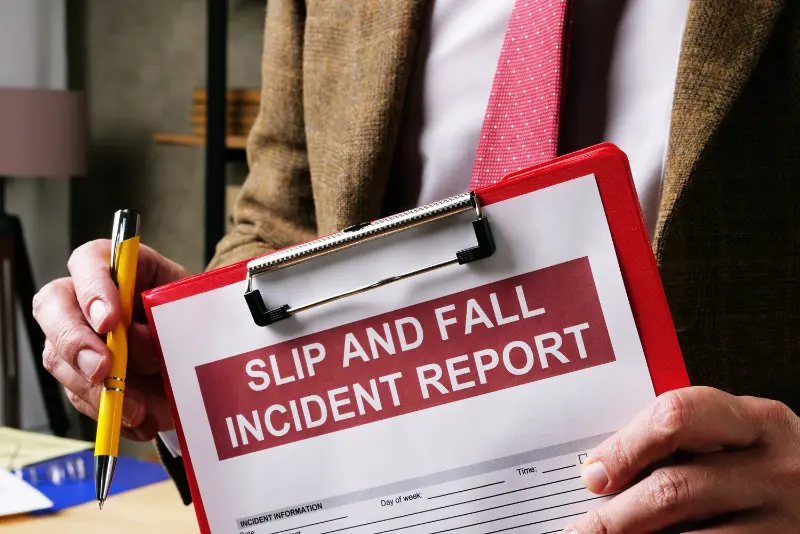
The moment an incident report is filed, the property owner’s insurer assigns a claims adjuster. That person’s job is not to help you — it’s to pay as little as possible. They will question whether the hazard was obvious, suggest you were distracted, ask about your shoes, and dig through your medical history looking for anything they can use against you.
Why so aggressive? Because slip-and-fall settlements are significant. A broken hip, a torn ligament, or a spinal injury can cost hundreds of thousands of dollars in medical care and lost wages. Our attorneys Matthew Blair and Oscar Ramirez have seen every one of these tactics. Insurers know this, and their strategy is to make victims doubt their own case — or accept a lowball offer before they fully understand what their injuries are worth.
How Negligence is proven in a fall
Proving negligence goes far beyond saying the floor was slippery. Courts want facts, timelines, and credible sources — which is why building a strong case starts immediately after the fall.
A California Supreme Court case of Richard Ortega is an example in which it is stated that Richard Ortega was shopping at a Kmart in Torrance when he slipped on a puddle of milk near the refrigerator aisle, tearing ligaments in his knee. He could not prove exactly how long the spill had been there. Kmart argued that without that proof, there was no case. The California Supreme Court disagreed. It ruled that a store’s failure to conduct regular inspections is itself evidence of negligence — and that a jury can reasonably infer the hazard existed long enough to be discovered and cleaned up. Kmart kept no written inspection records. That absence alone helped sink them. The court affirmed the jury’s verdict in Ortega’s favor, cementing a principle that still governs slip-and-fall litigation in California today. If you skip your inspections, you own the consequences.
We build cases with photographs, video footage, witness statements, maintenance records, and medical expert testimony that ties your injuries directly to the hazard — not to any prior condition an insurer might try to exploit. We apply this same approach in all our practices, including car accidents, motorcycle accidents, rideshare accidents, and wrongful death claims.
Why Documenting Injuries Changes Everything
Waiting to see a doctor is one of the costliest mistakes a fall victim can make. Many people hope the pain fades. Some avoid the bill. But every day without a medical record gives the insurance company room to argue your injury happened elsewhere — or was not serious enough to matter.
California law makes the stakes clear. Under CACI No. 3903A — Medical Expenses, Past and Future, the official jury instruction California courts use in personal injury cases, a plaintiff must prove “the reasonable cost of reasonably necessary medical care” they received — and the reasonable cost of care they will need in the future. That proof comes from one place: medical records. Without them, there is nothing for a jury to evaluate. Defense attorneys know this. A gap in your treatment history is not just a hole in your paperwork. It is an opening they will walk straight through, arguing your injuries were minor, pre-existing, or caused by something else entirely.
The principle holds across every slip-and-fall case we handle. Prompt, consistent documentation — from the emergency room to follow-up care to specialist visits — is what turns your injury into a provable claim. It connects the hazard to your body, your body to your losses, and your losses to a number a jury can award.
See a doctor today, not tomorrow. Then call us so that we can work on your case. We document your injuries from the start — medical records, photographs, pain journals, and expert evaluations that show exactly what this fall cost you.
How Much Compensation Can You Recover
This is the question people hesitate to ask. It’s also the most important one.
In a slip-and-fall case, you can pursue past and future medical expenses, lost wages, reduced earning capacity, pain and suffering, and emotional distress. In cases involving reckless disregard for safety, punitive damages are sometimes available, too.
A contractor who breaks an ankle on an unmarked wet floor, misses four months of work, and requires surgery and physical therapy could be looking at $80,000 to $150,000 or more — before pain and suffering enters the calculation. A senior who fractures a hip on a poorly lit staircase faces surgery, months of rehabilitation, and potential long-term care needs. Those cases routinely reach seven figures in California.
We build compensation claims with medical cost analyses, vocational expert reports, and documented evidence of how your injury changed your life. We never guess, and we never settle short.
Is There a Deadline to File Your Claim
Yes — and missing it can end your case entirely.
California gives most personal injury victims two years from the date of their injury to file a lawsuit. That window closes faster than it sounds. Security footage disappears within 30 to 60 days. Witnesses move on. Medical records become harder to track. If your fall happened on government property — a public sidewalk, a state building, a school — you have just six months to file a government tort claim.
We have seen people spend months recovering, finally feel ready to pursue their case, and then discover they have missed the government deadline. It is preventable; you can pursue it legally with us. Do not let it happen to you.
Frequently Asked Questions
What should I do immediately after a slip-and-fall accident?
Get medical attention right away, even if you feel fine. Document the scene — photograph the hazard, collect witness names and contact information, and ask for a copy of any incident report. Do not give a recorded statement to the property owner or their insurer before speaking with an attorney. Anything you say can be used to reduce your claim.
How do slip-and-fall cases work if I was partly at fault?
California follows a pure comparative negligence rule: you can still recover damages even if you share some responsibility. Your percentage of fault reduces your compensation. If a jury finds you 20% at fault on a $100,000 award, you receive $80,000. Our job is to minimize the fault attributed to you and build the strongest possible case for your recovery.
How long does a slip-and-fall case take to resolve?
Most cases settle within six to twelve months. Cases with serious injuries, contested liability, or uncooperative insurers may take longer. We keep clients informed at every stage so there are no surprises, and we push for the fastest resolution that still delivers the full compensation you deserve.
Do I need an attorney for a slip-and-fall claim?
Not legally — but practically, yes. Insurers have dedicated legal teams trained to minimize payouts. Without representation, you are negotiating against professionals who handle these claims every day. Represented victims consistently receive higher settlements. We work on contingency, meaning you pay nothing unless we win your case.
What if my fall happened at a store or restaurant?
Businesses open to the public carry a high duty of care. They must inspect regularly and address hazards promptly. If a spill sat unattended for 20 minutes and no one acted, that business may be liable. We investigate by pulling surveillance footage, requesting maintenance logs, and interviewing staff to establish exactly what the owner knew and when they knew it.
Can I sue a homeowner if I fell on their property?
Yes. Homeowners have the same legal duty to maintain safe conditions for guests. A broken step, an icy walkway, or poor outdoor lighting can all support a premises liability claim. The homeowner’s insurance typically covers these situations, and you may be entitled to full compensation for your injuries and losses.
What if the owner claims they did not know about the hazard?
“We didn’t know” is a common defense. It is not always a valid one. California law asks whether a reasonable property owner should have known — not just whether they actually did. If routine inspections were skipped or employees ignored a reported problem, the owner can still be held liable. We dig into inspection records and internal communications to expose exactly that.
What damages can I collect in a slip-and-fall lawsuit?
You can pursue economic damages — medical bills, lost wages, future care costs — and non-economic damages, including pain and suffering, emotional distress, and loss of enjoyment of life. In cases involving extreme Negligence, punitive damages may also apply. The total depends on the severity of your injuries and how thoroughly your case is documented and presented.
You Fell. Now Rise. Let Us Fight for What You Deserve.
A fall takes seconds. Its consequences — surgeries, medical debt, months away from work — can take years to climb out from. None of that should sit on your shoulders when someone else’s negligence puts you on the ground.
Understanding how slip-and-fall cases work is the first step. Acting on that understanding is the second. At Malibu Injury Lawyer, we handle the legal fight while you focus on recovering. No upfront costs. No fees unless we win. Just experienced representation from attorneys who know these cases — and know how to win them.
Call us today at +1 310-919-0868 or visit our Contact Us page for a free case review. The sooner you call, the stronger your case.